
About the teacher
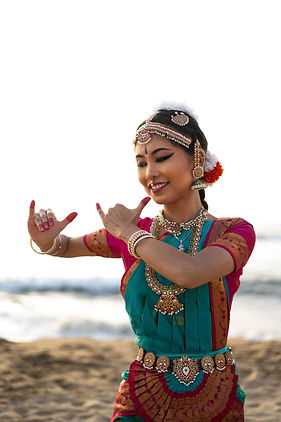
Srija Wang is a Bharatanatyam artist, choreographer, educator, and founder of Nrityaarpana School of Bharatanatyam. Her artistic practice is dedicated to preserving the integrity of Bharatanatyam while exploring intercultural dialogue through historically informed performance, research, and choreography. Through her work, she seeks to deepen public understanding of shared cultural heritage, movement traditions, and artistic exchanges across Asia.
Srija has trained in the Kalakshetra style of Bharatanatyam since 2015 under Guru Smt. Vanishree Ravishankar and Guru Kalaimamani Smt. Roja Kannan. In 2023, she began studying karanas under the direct guidance of Dr. Padma Subramanyam, completing her formal karana training in 2025 and continuing advanced choreography studies through Dr. Padma Subramanyam’s Nrtya Sangraha program. She completed her Bharatanatyam arangetram in Chennai, India, in 2023 and continues to travel to India for advanced training in dance, music, and related artistic disciplines.
Her choreographic work draws upon Bharatanatyam, Buddhist artistic traditions, poetry, mythology, and intercultural research. Recent works have explored themes of nature, spirituality, and embodied storytelling through movement and expression. She has performed in both India and the United States and has created original choreographies for students and community productions through her dance school and artistic initiatives.
Srija is currently developing Kalāsangama, an interdisciplinary dance production inspired by the Buddhist murals of the Mogao Caves and the historical cultural exchanges between India and China through Buddhism and the Silk Road. Through collaboration between Bharatanatyam and Dunhuang-inspired movement traditions, the project seeks to foster intercultural awareness and highlight the shared artistic histories that connect Asian classical traditions.
As both an artist and educator, Srija is committed to cultural preservation, rigorous classical training, and creating meaningful opportunities for artistic exchange, learning, and community engagement through dance.
Srija strictly upholds the traditional teaching approach and emphasizes the quality of dance. She will not compromise on the standard of dance for the sake of performance. She firmly believes that students should have a firm grasp of adavus and talam before learning and presenting an item on stage. If you expect your children to learn an item before they are thoroughly trained in adavu and talam, then my school is not suitable for you, as I do not believe in shortcuts in learning.
“Having studied different dance styles such as bellydance, ballet, contemporary, Indian folk and of course Bharatanatyam. I can confidently say that cross training in dance really helps you broaden your perspective and techniques as a dancer.”
Teaching approach
I believe that becoming a dancer involves far more than learning movements. To truly embody the art, one must understand the many interconnected aspects of the form. Since dance cannot be separated from music, my school provides foundational training in Carnatic music, along with instruction in proper tāla recitation and maintaining accurate kāla pramāṇam. I also guide my students through the historical evolution of Bharatanatyam, introducing them to the artists and scholars who have shaped the tradition. In addition, we study key theoretical concepts from texts such as the Abhinaya Darpaṇa, ensuring a comprehensive and holistic dance education.
Carnatic Music Knowledge
The dance cannot be separate from music. I teach important music knowledge as well as terminologies
Talam Knowledge
Students are required to recite adavus chollukattu and put into talam in all 3 speeds.
History
Student are taught historical knowledge of how this dance form evolved
Theory knowledge
Students are taught theory based on Abhinaya Darpana book.